

Golf Performance Lab
Measure | Improve | Play Better
7 Advanced Tests. A Stronger, Healthier Game.
Our Golf Performance Lab uses industry-leading technology to assess the key physical qualities that drive a more powerful, consistent swing, help prevent injury, and keep you playing your best for years to come.
The Science Behind the Lab
Stronger golfers swing faster. The research agrees.
Every test in our Golf Performance Lab is built on published sports science. A 2021 systematic review in the Journal of Strength and Conditioning Research looked at 20 studies and found that golfers who combined general strength work with golf-specific training gained an average of 4.1% clubhead speed and 5.2% hitting distance.
What we measure matters too. A 2023 study of national-level golfers found that the players with the fastest swings scored higher on the same qualities we test: lower-body strength, rate of force development, jump power and rotational power. Research on professional golfers has also linked limited lead-hip rotation with a history of low back pain, which is why hip mobility is part of every assessment.
We test, train what's holding you back, and retest so you can see the progress.
What We Measure
Seven objective tests, each tied to a physical quality that shows up in your swing — so your training is built on data, not guesswork.

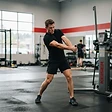
Rotational Power
How much force you can produce and transfer through rotation — the engine behind clubhead speed.
- Hit the ball farther with less effort
- Transfer energy more efficiently through the swing
- Reduce stress on the lower back and hips


Lower-Body Peak Force
How much force your legs can drive into the ground, the foundation of a powerful, stable swing.
- More power and distance off the tee
- Better balance and stability through impact
- Lower risk of knee and hip injury

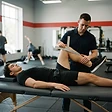
Hip Rotational Mobility
How much rotation you have in each hip — one of the biggest limiters of a full shoulder turn.
- Greater hip turn and more power in the swing
- Smoother, more fluid movement through the ball
- Less stress on the hips and lower back

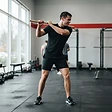
Thoracic Rotation
How well your mid-back rotates — the quality that drives your shoulder turn and keeps the club on plane.
- A fuller, more efficient turn away from the ball
- More consistent ball striking
- Less strain on the shoulders and lower back

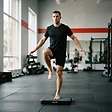
Single-Leg Postural Control
How well you can balance and control your body weight on each leg through the swing.
- Greater stability and control on uneven lies and slopes
- Improved single-leg strength and athleticism
- Less risk of falls and lower-body injury

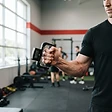
Grip Strength
How much force your hands can produce, which influences club control and how hard you can safely swing.
- Better club control and face awareness
- More control with longer clubs and out of the rough
- Lower risk of wrist, elbow and hand injury

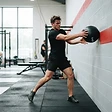
Rate of Force Development
How quickly you can produce force — the quality that separates a fast, explosive swing from a slow one.
- More clubhead speed
- Faster, more explosive movement
- Better athletic performance on the course
The Muscles Behind Your Golf Swing
Every phase of the swing calls on different muscle groups. Here is what is working, when it works, and the lab test that measures it.
What Fires in Each Phase
Numbers match the body map above.Feet planted, posture set, clubface aimed. The body braces before anything moves.
- 5Obliques & Core
- 7Glutes
- 10Hamstrings
The coil. Shoulders turn against a quiet lower body and load the trail side.
- 4Lats & Upper Back
- 2Shoulders & Rotator Cuff
- 8Hip Rotators & Adductors
- 7Glutes
The lower body fires first: hips open, then the chest and arms follow in sequence.
- 9Quads
- 5Obliques & Core
- 3Chest
- 7Glutes
Force transfers up the chain while the arms square the face and speed peaks.
- 3Chest
- 5Obliques & Core
- 9Quads
- 1Forearms & Grip
The body decelerates and absorbs the speed it just created.
- 2Shoulders & Rotator Cuff
- 6Lower Back
- 10Hamstrings
- 1Forearms & Grip


A Stronger Body Builds a Better Game.
Move Better | Get Stronger | Play Longer